

The Pocket Science Lab: Who Needs it, and Why
Science and technology share a symbiotic relationship. The degree of success of experimentation is largely dependent on the accuracy and flexibility of instrumentation tools at the disposal of the scientist, and the subsequent findings in fundamental sciences drive innovation in technology itself. In addition to this, knowledge must be free as in freedom. That is, all information towards constructing such tools and using them must be freely accessible for the next generation of citizen scientists. A common platform towards sharing results can also be considered in the path to building a better open knowledge network.
But before we get to scientists, we need to consider the talent pool in the student community that gave rise to successful scientists, and the potential talent pool that lost out on the opportunity to better contribute to society because of an inadequate support system. And this brings us to the Pocket Science Lab
How can PSLab help electronics engineers & students?
This device packs a variety of fundamental instruments into one handy package, with a Bill-of-materials that’s several orders of magnitude less than a distributed set of traditional instruments.
It does not claim to be as good as a Giga Samples Per second oscilloscope, or a 22-bit multimeter, but has the potential to offer a greater learning experience. Here’s how:
- A fresh perspective to characterize the real world. The visualization tools that can be coded on an Android device/Desktop (3D surface plots, waterfall charts, thermal distributions etc ), are far more advanced than what one can expect from a reasonably priced oscilloscope. If the same needs to be achieved with an ordinary scope, a certain level of technical expertise is expected from the user who must interface the oscilloscope with a computer, and write their own acquisition & visualization app.
- Reduce the entry barrier for advanced experiments.: All the tools are tightly integrated in a cost-effective package, and even the average undergrad student that has been instructed to walk on eggshells around a conventional scope, can now perform elaborate data acquisition tasks such as plotting the resonant frequency of a tuning fork as a function of the relative humidity/temperature. The companion app is being designed to offer varying levels of flexibility as demanded by the target audience.
- Is there a doctor in the house? With the feature set available in the PSlab , most common electronic components can be easily studied , and will save hours while prototyping new designs. Components such as resistors, capacitors, diodes, transistors, Op-amps, LEDs, buffers etc can be tested.

How can PSLab help science enthusiasts ?
Physicists, Chemists and biologists in the applied fields are mostly dependent on instrument vendors for their measurement gear. Lack of an electronic/technical background hinders their ability to improve the gear at their disposal, and this is why a gauss meter which is basically a magnetometer coupled with a crude display in an oversized box with an unnecessarily huge transformer can easily cost upwards of $150 . The PSLab does not ask the user to be an electronics/robotics expert , but helps them to get straight to the acquisition part. It takes care of the communication protocols, calibration requirements, and also handles visualization via attractive plots.
A physicist might not know what I2C is , but is more than qualified to interpret the data acquired from a physical sensor, and characterize its accuracy.
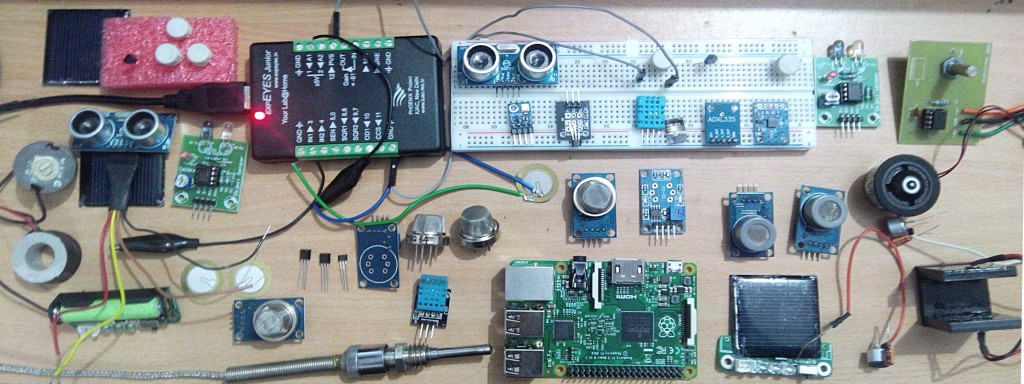
- The magnetometer (HMC5883L) can be used to demonstrate the dependence of the axial magnetic field on distance from the center of a solenoid
- The pressure,temperature sensor (BMP280) can be used to verify the gas laws, and verify thermodynamic phenomena against prevalent theories.
Similarly, a chemist can use an RGB sensor (TCS3200) to put the colour of a solution into numbers, and develop a colorimeter in the process. Colorimeters are quite handy for determining molality of coloured solutions., and commercial ones are rather expensive. What it also needs is a set of LEDs with known wavelengths, and most manufacturers offer proper characterisation information.
What does it mean for the hobbyist?
It is capable of greatly speeding up the troubleshooting process . It can also instantly characterize the expected data from various sensors so that the hobbyist can code accordingly. For example, ‘beyond what tilt threshold & velocity should my humanoid robot swing its arms forward in order to prevent a broken nose?’ . That’s not a question that can be easily answered by said hobbyist who is currently in the process of developing his/her own acquisition system.
How can we involve the community?
The PSLab features an experiment designer that speeds acquisition by providing spreadsheets, analytical tools, and visualisation options all in one place. An option for users to upload their new experiments/utilities to the cloud, and subject those to a peer-review process has been planned. Following which , these new experiments can be pumped back into the ecosystem which will find more uses for it, improve it, and so on.
For example , a user can combine the waveform generator with an analog multiplier IC, and develop a spectrum analyzer.

The case for self-reliance
The average undergraduate laboratory currently employs dedicated instruments for each experiment as prescribed by the curriculum. These instruments often only include the measurement tools essential to the experiment, and students merely repeat the procedure verbatim. That’s not experimentation, it’s rather just verification. PSLab offers a wide array of additional instruments that can be employed by the student to enhance the experiment with their own inputs.
For example, a commonly used diode IV curve-tracer kit usually has a couple of power supplies, a voltmeter, and an ammeter. But, if a student wishes to study the impact of temperature on the band gap, he will hard pressed for the additional tools, and software to combine the acquisition process. With the PSLab, however , he/she can pick from a variety of temperature sensors (LM35, BMP180, Si7021 .. ) depending on the requirement, and explore beyond the book. They are thus better prepared to enter research labs .

And in conclusion , this project has immense potential to help create the next generation of scientists, engineers and creators.
Resources
- PSLab-Firmware : Source code and documentation for the firmware
- PSLab-hardware : Layouts, Schematics, and other hardware design files
- PSLab-python : Python Communication library
- PSLab-desktop-apps : Experiment related applications built with the Qt Toolkit
- PSLab-android : Android app for the Pocket Science Lab
You must be logged in to post a comment.